
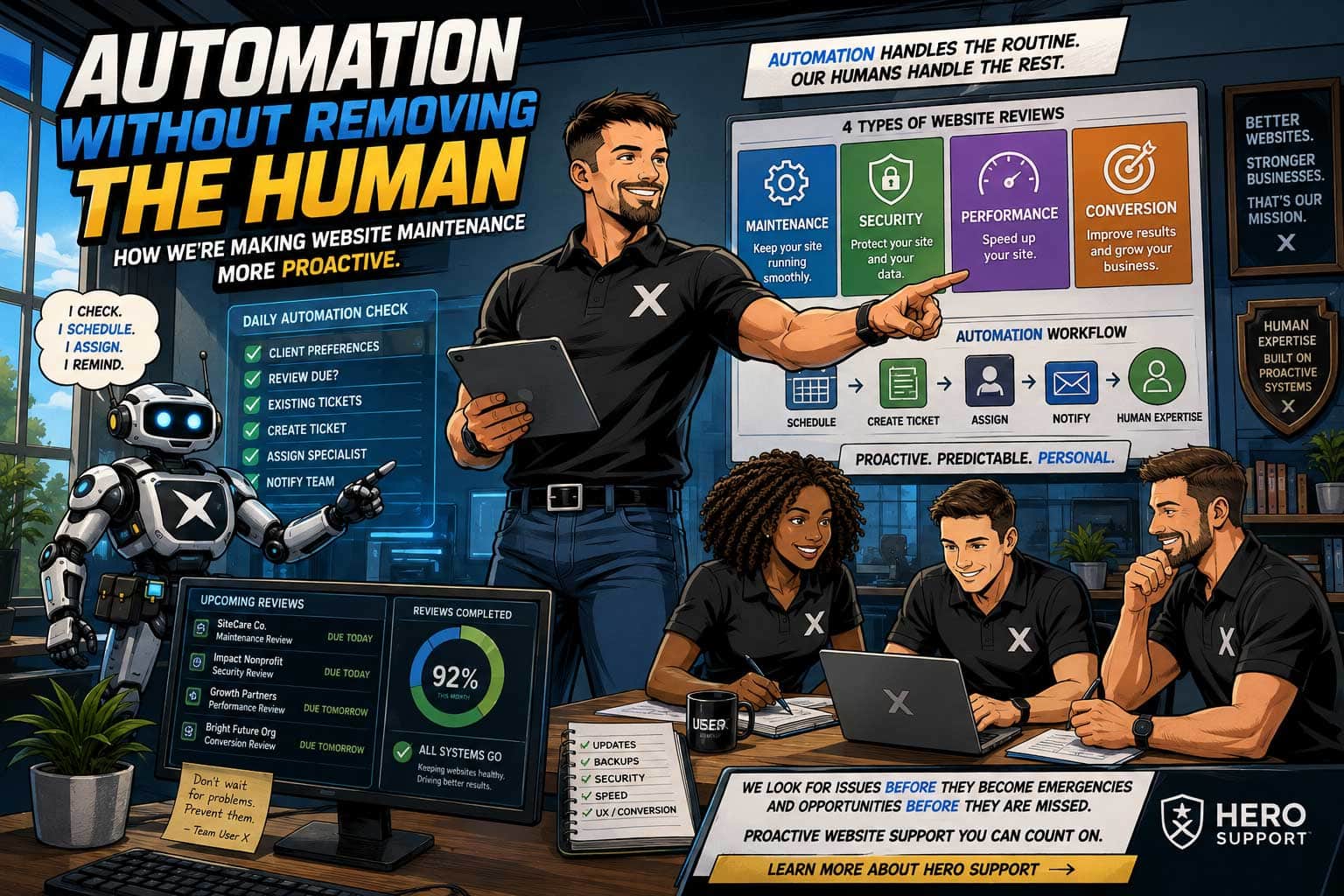
There’s a lot of conversation right now about AI agents—software that can evaluate situations, make decisions, and take action with limited human involvement. But when it comes to website maintenance automation, we believe the goal shouldn’t be removing people from the process. It should be making sure the right work gets done by the right people at the right time.
That’s the approach behind User X Hero Support. We’ve upgraded our internal support system to automatically schedule proactive maintenance, security, performance, and conversion reviews based on each client’s needs. The automation handles the scheduling, tracking, and routing; our team provides the experience and judgment.
Because sometimes the smartest automation isn’t an AI agent at all. It’s a reliable system that makes sure important work never falls through the cracks.
The Problem With “Remembering” Maintenance
Website maintenance is easy to postpone.
A plugin update isn’t urgent until it causes a problem. A gradually slowing website doesn’t generate an emergency ticket. Nobody calls because a homepage’s call-to-action could be 20% more effective.
These things matter, but they rarely scream for attention.
For User X Hero Support, relying on someone to remember every client’s maintenance schedule isn’t a good system. As the number of clients grows, the problem gets worse.
We wanted our support system to answer a simple question every day:
Does any client need our attention today?
Four Different Kinds of Website Reviews
One of the things we realized while building the system was that “website maintenance” is actually several different jobs.
We’ve separated proactive website care into four types of reviews:
Maintenance Checks
These cover routine operational health: WordPress core, plugins, themes, basic functionality, and other issues that can accumulate over time.
This is the regular housekeeping that keeps a WordPress website healthy.
Security Checks
Security requires a different level of attention.
These reviews can include user access, security logs, backups, malware protection, vulnerabilities, and whether appropriate security measures are in place.
Performance Checks
A website can function perfectly and still perform poorly.
Performance reviews look at site speed, caching, optimization, Core Web Vitals, large assets, scripts, and other potential bottlenecks.
Conversion Checks
A technically healthy website can also fail at its actual job.
Conversion reviews ask different questions:
Is the site’s primary goal clear? Are calls-to-action effective? Do forms work? Is there unnecessary friction between a visitor and the action we want them to take?
This moves maintenance beyond simply asking, “Is the website working?”
We’re also asking, “Is the website working for the business?”
Different Reviews Need Different Schedules
Not every website needs every review every month.
Our system stores each client’s maintenance preferences and determines when particular reviews are due.
A routine maintenance check may happen frequently, while a deeper performance, security, or conversion review might happen quarterly.
The system also looks at previous tickets before creating anything new.
If a review is already assigned or in progress, we don’t need another one.
If it was recently completed, we wait until the next cycle.
If an optional review was cancelled, we don’t blindly recreate it the next morning. The cancellation effectively skips that review cycle.
The result is automation that follows predictable business rules instead of simply generating more tickets.
The Right Work Can Go to the Right Person
Separating these reviews also solves another problem as a support team grows.
Not every task requires the same skill level.
Routine WordPress maintenance can be handled by someone trained in our maintenance procedures. A security review may need a more experienced technical specialist. Performance optimization requires a different skill set. Conversion analysis may be better suited to someone with marketing and user-experience experience.
Because each review is its own ticket type, our system can route different kinds of work to different team members.
That creates a path for delegation without sacrificing quality.
It also creates a training path. Someone can become proficient at routine maintenance before taking on increasingly technical responsibilities.
Automation Handles the Routine. Humans Handle the Judgment.
This distinction matters.
Our automation can determine that a security review is due.
- It can create the ticket.
- It can assign the right person.
- It can provide a defined set of tasks.
- It can send reminders and track whether the work gets completed.
But the automation isn’t deciding whether an unusual administrator account represents a legitimate employee or a security problem. It isn’t deciding whether a slow homepage needs image optimization, a caching change, or development work. And it isn’t deciding whether rewriting a call-to-action makes sense for a client’s business.
Those decisions still require human judgment.
When our team discovers something outside the scope of a routine review, we can create a separate User X Suggested ticket explaining what we found, why it matters, and what we recommend doing about it.
The client can then decide whether to move forward.
That separation is important. Automation helps us discover opportunities and risks consistently without giving software unlimited permission to make changes to a client’s website.
Not Every Automation Needs AI
This project reinforced something we’ve increasingly come to believe:
Use AI where intelligence is valuable. Use conventional automation where predictability is valuable.
There was no compelling reason to put an AI agent in charge of deciding whether 30 or 90 days had elapsed since a website’s last review.
That’s a rules problem.
Rules are inexpensive, testable, predictable, and easy to audit.
AI becomes much more interesting when the problem requires interpretation—analyzing performance results, identifying patterns, evaluating content, summarizing findings, or helping a human determine the best response.
Knowing the difference matters.
The goal shouldn’t be to put AI into every business process.
The goal should be to build better business processes.
What This Means for Our Clients
Most of this system will operate quietly in the background.
That’s intentional.
Clients shouldn’t have to remember that their website is due for a review. Our team shouldn’t have to maintain a spreadsheet or depend on someone’s memory either.
The system keeps track of the routine so our people can concentrate on the part that actually requires expertise.
For our clients, that means website support becomes less reactive.
Instead of waiting for:
- something to break,
- a security problem to appear,
- performance to deteriorate,
- or someone to notice that a website isn’t producing results,
we’re creating a process designed to identify those issues earlier.
Technology is doing what technology does well: remembering, scheduling, routing, and tracking.
Our people are doing what people do well: evaluating, deciding, communicating, and solving problems.
That’s the kind of automation we’re interested in building at User X—not automation that removes humans from the equation, but automation that helps good people do better work.
Make Your Website One Less Thing You Have to Remember
Your website shouldn’t depend on someone noticing that it’s time for an update, security review, or performance check.
User X Hero Support combines proactive automation with experienced human oversight to keep your WordPress website maintained, monitored, and moving toward your business goals.
We handle the routine. We look for problems before they become emergencies. And when we find opportunities to improve your site, we bring you clear recommendations—not surprise invoices.